





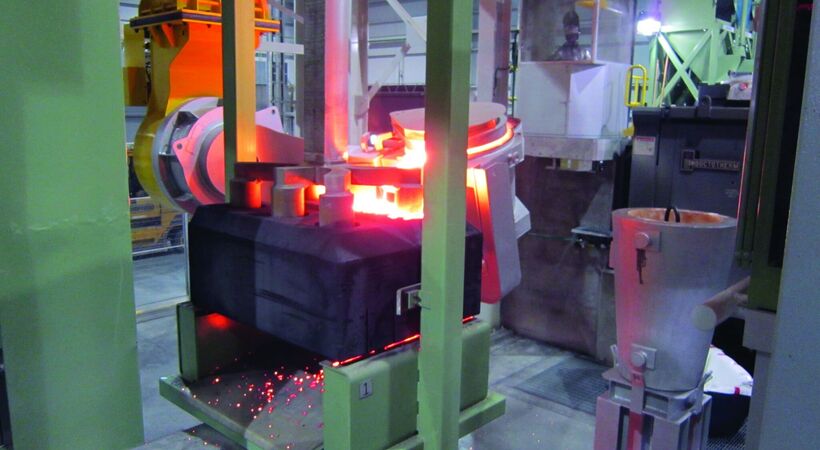
Since starting at Fives in 1989, Pablo Arribalzaga, Managing Director Europe, Fives North American Combustion, has observed considerable growth in the group’s size, with turnover up by 200%.
The differences between North America and Europe are widely recognised, the two regions have different cultures, attitudes, and goals.
But this is also the same for countries within Europe: “We have common rules and techniques, but culturally we are different,” said Pablo.
But one thing that connects both regions is the “mindset of developing new things and improving the quality of the industry today.”
“On both sides [of the pond] we would like to be more sustainable.
However, in North America they are most concerned about NOx emissions, whereas in Europe they are more concerned about energy costs,” Pablo said.
But could the agenda shift with the arrival of the Trump administration?
Since Trump took office earlier this year, the world has experienced a series of developments related to trade, tariffs and international relations in particular.
Pablo noted it is too early to predict and understand how the administration will affect the global aluminium industry. While past experiences can offer insights into the future, history is not a fortune teller, he states.
The global industry’s response will vary, but working with both regions, as well as with the Middle East, Pablo is particularly interested in the comparison between the US and Europe.
“It’s complex because what may work for the US side may not work for the European side.
“In Europe, we manufacture our best-selling product, while in the US, we produce the entire product portfolio. We will be affected by local policies but to a lesser extent.”
Fives works throughout North America, with 23 subsidiaries located across Mexico, Canada, and the US.
Pablos states: “Fives in an international group with a strong local footprint with over 100 locations in 24 countries.
“Our organisation enables us to adapt to the shifts in the industrial and geopolitical worlds. We are global but we act local.”
Renewable fuels
It is believed sustainability will continue to advance and evolve despite global challenges and Pablo states: “I think the aluminium industry will continue to become greener.”
Fives has a long history in research and development, with many of its current ventures focused on sustainability.
Pablo noted a couple of collaborative projects where Fives is working with companies such as Ma’aden, where it will reduce emissions by 40% in the furnace, or a project in Germany, where it has modified furnaces and reduced emissions by 35%.
Turning the discussion to hydrogen, Pablo states: “Fives North American Combustion was one of the first companies to test with hydrogen on an industrial scale.”
A paper on its hydrogen tests with Hydro was premiered at this year’s recent TMS show in Las Vegas.
The paper reported the results seen when producing recycled aluminium with hydrogen.
The study detailed the results of combining Fives’ regenerative burners, that recover waste heat from furnace exhaust gases to preheat the combustion air, and hydrogen that reduce carbon and NOx emissions.
Pablo said: “We can make use of 100% natural gas, or 100% hydrogen.
"We can mix fuels, but the outcome is the same, our customer can reduce their emissions to zero.”
Hydrogen has been a re-occurring theme across the decarbonisation narrative, but is there a future for hydrogen, and if so, where?
Pablo responds simply: “In Europe.”
According to the European Union website, in 2022, hydrogen accounted for less than 2% of Europe’s energy consumption. 96% of this hydrogen was produced with natural gas, resulting in significant CO2 emissions.
That being said, hydrogen plays a huge role in the EU’s plan for a renewable future. The REPowerEU Strategy of 2022 laid out the targets: Producing 10 million tonnes and importing 10 million tonnes of renewable hydrogen by 2030.
There are three EU hydrogen initiatives: the Clean Hydrogen Partnership, The European Clean Hydrogen Alliance and the Hydrogen Public Funding Compass.
Pablo believes hydrogen is a viable fuel for the future.
“Europe is investing. We want to have an independent fuel source that does not rely on external relations.
“The idea is to start producing. Whether the whole of Europe will use hydrogen is a different question.
"The likely situation will be that different areas will rely on different fuels, like biomass or nuclear.”
Environmental sustainability is not the only agenda on the Fives sustainability roadmap. “Sustainability for Fives also includes working with regions to provide them with local resources and support,” he states.
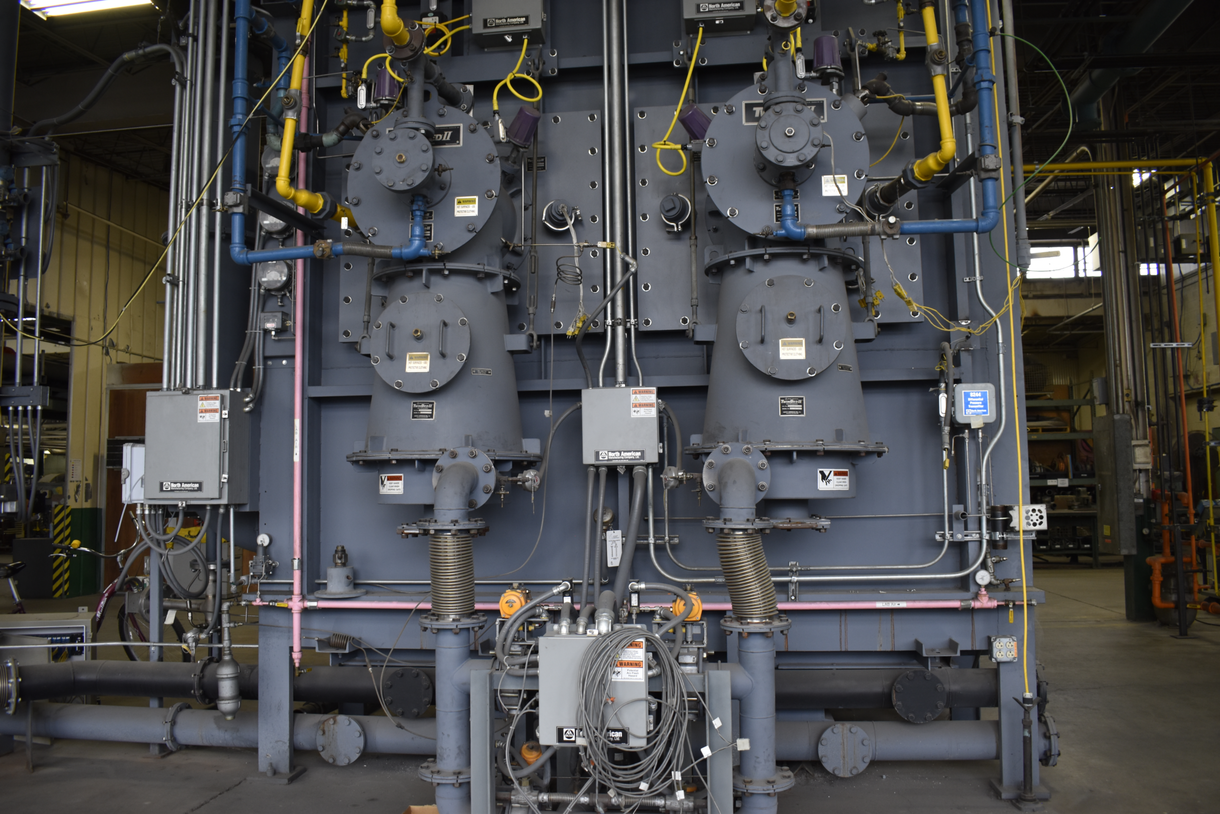
The North American Twinbed II is made up of an ultra-low NOx burner and a regenerative bed. Together, they recover waste heat from furnace exhaust fumes.
Digitalisation in industry
Fives’ subsidiary Fives ECL is based in Lille, France. The company (ECL 1947) joined the Fives group in 2015, and predominantly works for primary aluminium smelters.
With almost 300 employees, Fives ECL has a highly robotised and digitalised 18,000m2 manufacturing facility.
Florent Grumiaux, Managing Director, Fives ECL, states it is also working with European companies and countries on carbon capture and storage projects.
Fives also has a huge involvement in the digitalisation of technology. For the aluminium industry the implementation of artificial intelligence (AI) is a huge topic. But how does this link in with Fives?
Florent states: “AI will be a tool used by our team to be more efficient or to reduce the stress on some tasks.
"It’s something we’re starting to implement. But we are aware we also must be cautious with how we use it.”
One of the main challenges in implementing digital technologies is building a database.
This aligns with the familiar call from the industry for companies to track and record data and share this data so that digitalisation can push forward.
Florent shared an example of data-driven improvements in efficiency and emissions.
By collaborating with Aluminium Dunkerque, Fives analysed data to optimise operations, successfully reducing furnace gas consumption by 5%
“Our target is not to trash everything and to redo it. Our target is to optimise and be responsible,” he states.
The use of technology to enhance efficiency and sustainability is justification for its implementation, but a slightly less obvious reason is its role in tackling a deindustrialising world.
A shrinking workforce in the industrial sector is a serious issue. Digitalisation has allowed technology to replace human labour, enabling operations to be run by fewer individuals.
A focus on continuous development and upgrading machinery is implemented in Fives’ ECL mindset towards manufacturing itself.
Florent states: “When you compare the past to how things are run in the present, thanks to years of research and development, we have completely changed the way of manufacturing, and our future is also continuing to change.”
Technology is also valuable for preserving knowledge. As skilled employees retire, technology can be used to capture and store their expertise, ensuring it is not lost.
But there will always be a limit. Pablo states clearly that technology will never 100% replace humans.
Replacing humans with humans
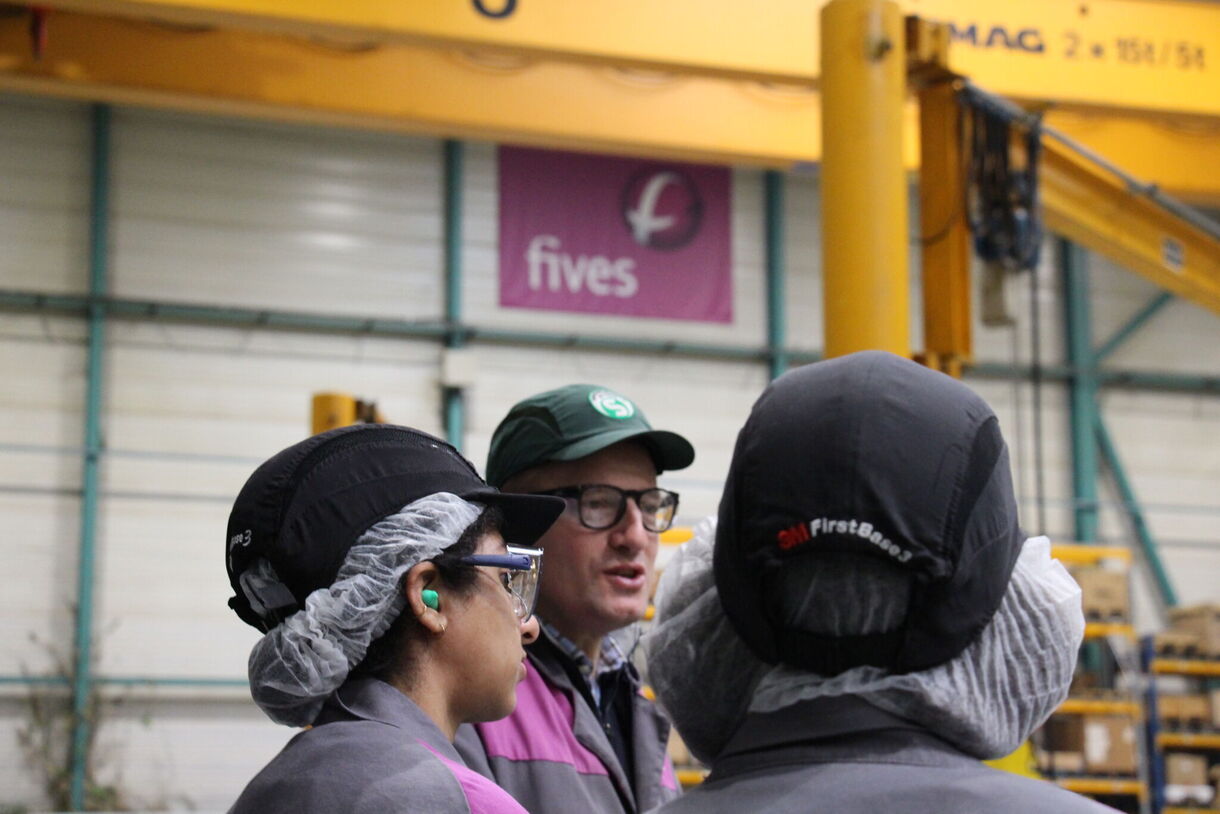
Fives ECL runs initiatives that engage college students in programmes related to manufacturing.
Florent emphasised the importance of introducing young people to the industry.
“Because they don’t know how the industry works, and they often have a bad image of the industry, we have created a network that works with schools and universities to explain how working in industry is rewarding.
“We show them that we are making an impact, we can change things, we can improve and make life easier for people who are using our materials or product.”
Fives ECL has welcomed 20 apprentices this year to the company. Speaking to Pablo and Florent it is clear that bringing new, younger employees to the company is an investment Fives is committed to.
Florent also discussed virtual reality (VR) and simulations that have been produced to assist training.
This was a way to “remove people from the danger zone, while exposing them to the knowledge and equipment.”
Addressing the industry
When asked what message he would share with the entire industry, Pablo said: “The industry has to continue on the path that we have started on to improve decarbonisation and we must speed up this process.”
Florent added: “We are looking for the last percent [of emissions], everything counts.
"Even the detail. we are looking for continuous improvement, we don’t expect a huge, big step. But we need to improve step by step."
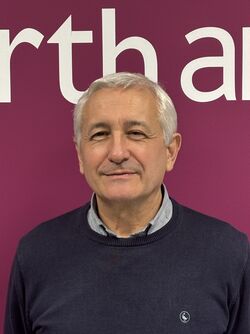
Pablo Arribalzaga, Managing Director Europe, Fives North American Combustion
Pablo started his career as an apprentice working in an aluminium foundry, and since then he has spent “all my career in the in the combustion and furnaces industry.”
He joined Fives Stein, another subsidiary of Fives group, and became the Managing Director for Europe of Fives North American Combustion in 2011.
“Fives is a company that has a lot of heritage and industrial culture. It is a company that has been in the market for over 200 years. You can imagine that the company has had to evolve dramatically, with each evolution of the industry.” – Pablo
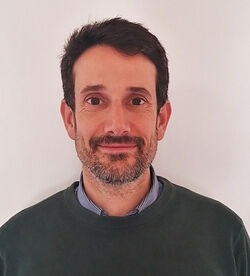
Florent Grumiaux, Managing Director, Fives ECL
Florent started work at ECL in 2000 (before it was acquired by Fives).
Starting at the company as an apprentice, he “changed role ten times,” and worked his way up from the workshop floor to become the Managing Director of Fives ECL.
“We are a team of passionate guys. We are all driven by this willingness to develop and to improve.” – Florent